How Triuvo Converted a Legacy ERP into a Reliable Layer of Financial Control and Autonomous Off-Grid Logistics During Network Isolation In the modern industrial and financial landscape, logistics and real estate conglomerates have constructed their operational frameworks upon a highly fragile assumption. That assumption is the permanent availability of global digital connectivity and the inherent reliability of their internal reporting systems. However, as the scale of these organizations expands, a dangerous paradox emerges. The system exists, and the information exists, but there is no real control. This was the exact operational reality facing Gremco, a major real estate and asset holding company managing complex material acquisitions, intensive contract workflows, and volatile commodity pricing.
Many organizations operate with legacy systems that meticulously record daily operations but fundamentally fail to allow leadership to understand or govern those operations. The system functions. The data exists. The reports are generated. But the information is not consistent. Response times are agonizingly slow. Critical decisions depend entirely on manual interpretations, and every individual department operates with its own fragmented version of reality. The ultimate result is not a lack of information; it is a complete lack of control. The operation continues to move forward, but the capacity of the leadership to make precise, financially sound decisions deteriorates rapidly.
Gremco was experiencing this exact illusion of control. Their financial operation was growing massively in both volume and complexity, but their capacity for governance was stagnant. They managed an intensive operation involving vendor contracts, collection flows, and financial structures tied to real estate assets. The data was dutifully recorded in their legacy Enterprise Resource Planning systems, but these systems did not allow for a consolidated reading or a consistent validation of their financial reality. Every core process, including billing, collections, conciliation, and portfolio tracking, depended on multiple conflicting sources, non-standardized rules, and endless manual validations.
This environment generated a severe operational fragmentation. The contract division lacked structured data to trace expected revenues directly. The treasury department operated without an integrated, reliable vision of actual cash flow. The reconciliation between billing, actual collections, and portfolio status required constant human intervention. The problem facing Gremco was not a lack of software systems; it was the sheer impossibility of converting their daily operations into a reliable foundation for executive decision-making. The operation existed, but it was fundamentally ungovernable.
Adding to this internal chaos was the existential risk of modern technological adoption. The use of artificial intelligence in corporate environments is no longer a strategic choice; it is an operative reality. Legal, financial, and operational teams routinely use external commercial tools to analyze contracts, evaluate financial structures, and process sensitive information simply to keep up with their daily workload. However, the problem is not the use of intelligence. The problem is where that use occurs.
Every single interaction with an external commercial system involves processing critical corporate information outside the control of the organization. This is not happening as a rare exception, but as a habitual part of the operational workflow. This practice introduces a progressive, invisible transfer of internal corporate knowledge toward infrastructures that do not belong to the company. The cost of this data leakage is not immediate, nor is it highly visible in the short term, but it is deeply cumulative. The critical question for an enterprise is no longer whether to use artificial intelligence. The question is under whose control that intelligence operates. Because if the infrastructure is not yours, the intelligence is not yours either.
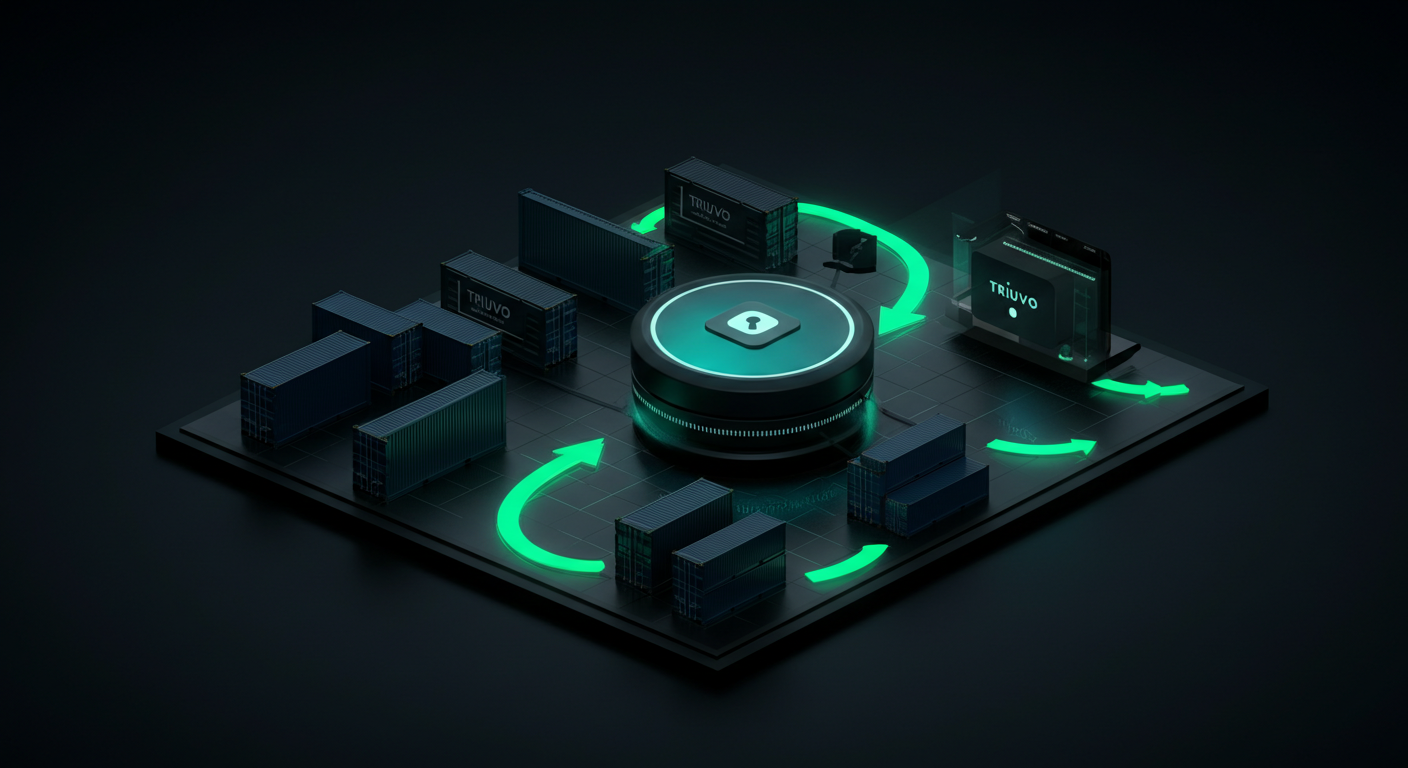
To solve this dual crisis of internal fragmentation and external vulnerability, Gremco did not incorporate yet another generic artificial intelligence tool. They recovered absolute control of their operation through the deployment of the Aquinas Engine. Triuvo structured an architecture of absolute sovereignty over Gremco's financial operations and internal knowledge. This architecture was deployed as a superior cognitive layer, capable of integrating, modeling, and supervising the entire operation without requiring the replacement or interruption of their existing legacy systems.
The foundation of this solution is the Sovereign Infrastructure. Triuvo implemented an isolated processing environment characterized by a strict Zero-Retention policy. All financial and operational information is maintained exclusively within the physical perimeter of Gremco. Not a single byte of sensitive data is exposed to external cloud infrastructures. Operating upon this secure foundation is a custom cognitive model. The Aquinas system was trained and configured exclusively on Gremco’s historical data, deeply incorporating their specific financial criteria, their unique operational logic, and their proprietary methods for evaluating risk. The system does not respond like a generic, internet-trained model. It reasons exactly like the organization itself.
This custom engine powers an active surveillance layer known as Sentinel. Every new operation, every incoming logistics manifest, and every treasury movement is evaluated in real time against the historical baseline and the established contractual rules. The system detects capital deviations, logical inconsistencies, and unhedged risks long before they can materialize into financial losses. Contracts, billing, collections, and conciliations were finally structured into a unified model, allowing for direct, immediate traceability between contractual commitments and actual financial execution. By defining consistent operational rules, Aquinas automatically validates the coherence between legal contracts and financial flows, eliminating the crippling dependence on manual validations and reducing ambiguity in executive decision-making.
The impact of this sovereign deployment was immediate and transformative. Gremco ceased operating on assumptions and began operating on structured, consistent, and traceable information. Decisions that previously took weeks of manual reconciliation became immediate, comparable, and deeply founded in mathematical certainty. Financial and operational risk ceased to be an invisible threat; it became identifiable, measurable, and manageable. The operation stopped scaling solely in complexity and finally began to scale in control.
This robust internal governance directly enabled autonomous, off-grid logistical capabilities. Because the intelligence layer resided physically on-premise, Gremco could manage real-time commodity pricing and contract reconciliation for their materials yards even during complete communication blackouts. When external internet connectivity failed, the Triuvo Node continued to audit incoming manifests, calculate exact pricing based on internal matrices, and enforce contract compliance without missing a beat. Gremco proved that the difference between merely operating and truly governing an enterprise is not a matter of software tools. It is a matter of structural architecture.